
Review of MacEachern, "Becoming Green Gables: The Diary of Myrtle Webb and Her Famous Farmhouse"
May 27, 2026
Please see PDF for full citations + bibliography.
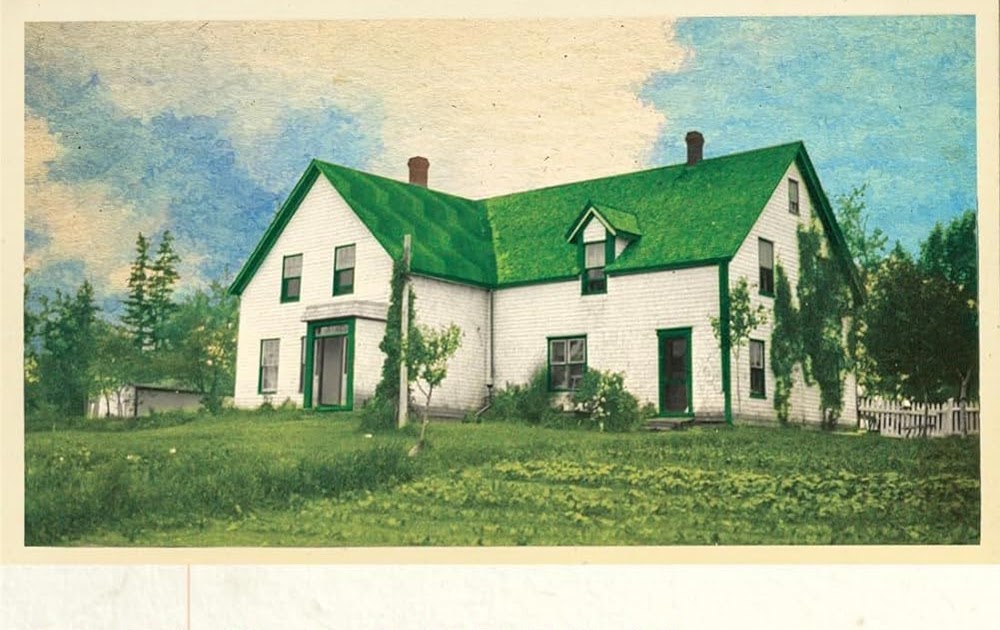
The Green Gables Farmhouse is one of the most recognizable houses in Canada. Every year, hundreds of thousands of tourists and literary pilgrims travel to Prince Edward Island to visit Green Gables Heritage Place. There is an abundance of scholarly literature (and a biennial conference) devoted to the study of Lucy Maud Montgomery and her work; primarily Anne of Green Gables (1908). However, there is arguably less research on the Green Gables Farmhouse itself. Environmental historian Alan MacEachern is the leading historian on the Farmhouse, with research conducted on both Prince Edward Island National Park and the Green Gables homestead. Though Montgomery wrote Anne of Green Gables, she had little to do with the Farmhouse becoming a realized fictional setting. MacEachern’s 2024 book, Becoming Green Gables: The Diary of Myrtle Webb and Her Famous Farmhouse, unveils the history of a home turned into a tourist attraction, challenging the narrative that Parks Canada has historically concealed from visitors. In critically examining the diaries of Myrtle Webb, MacEachern successfully illustrates how Myrtle and Ernest Webb, as well as their neighbours in Cavendish (PEI), actively participated in transforming Cavendish from a rural economy to a local economy dependent on tourism.
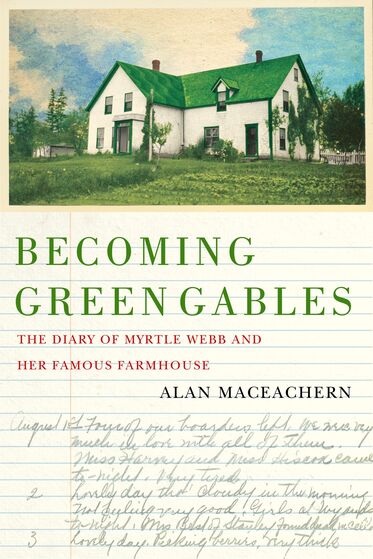
Becoming Green Gables examines the Webb family dynamics between from 1924- 1945 through historicizing the entries of Myrtle Webb’s diaries. Readers who are familiar with Montgomery’s diaries—of which the entries are typically long and prosaic—may be surprised to see the brevity of Myrtle’s entries. Myrtle’s entries are comparable to work logs and require contextualizing to understand. This is MacEachern’s third work that touches on the history of Prince Edward Island: his first being Natural Selections: National Parks in Atlantic Canada, 1935–1970 (2001) — featuring a chapter on Prince Edward Island National Park —and the second being The Summer Trade: A History of Tourism on Prince Edward Island (2022), coauthored with Prince Edward Island historian Edward MacDonald. MacEachern’s previous scholarly works and continued interest in the knowledge provide the ability to transform the entries of Myrtle Webb’s diary: they shift from a jumble of work notes, weather observations, guest book entries, and retellings of community events and drama, into the history of the transformation and modernization of Cavendish through tourism.
Despite her diary entries being the main primary material for this project, this book is not a biography of Myrtle Webb. MacEachern uses 10 entries per year from Myrtle’s diary, up until Myrtle and Ernest’s eviction from the Parks Branch in December 1945. MacEachern’s choices are carefully and thoughtfully selected to portray personal, familial, community, and national narratives: he is able to balance the Webb’s personal lives, the surrounding community of Cavendish, and the construction of a national park to identify this period of change in Cavendish. MacEachern pairs the diary entries with a variety of other rich primary sources, including correspondence between Myrtle and L.M. Montgomery, Montgomery’s own journals, articles from the Charlottetown Guardian, and records from the Public Archives and Record Office of Prince Edward Island. These sources are additionally supported by visual materials such as family photographs, maps, and tourism materials.
MacEachern concludes this book by writing, “[t]he story of the Webbs of Green Gables deserves to be remembered because of their importance not to the site’s prehistory but to its history. The Webbs made Green Gables.” With this, MacEachern opens the door for future historical research to be done on the Green Gables Farmhouse and the Webb family and to continue challenging the narrative that Parks Canada presents at the gates of Green Gables Heritage Place—both digitally and at the physical site. For researchers and historians, perhaps the most exciting aspect of Becoming Green Gables is that the farmhouse is not confined to the pages of this book. As part of this project, MacEachern and his team created a virtual exhibit to digitize and transcribe Myrtle Webb’s diaries, which can be accessed using this link. Here, high-quality scans are paired with transcriptions, allowing researchers globally to read and critically evaluate the diaries. The website also includes family photos, memorabilia, some “introductory text to ground the reader.” The research on the Green Gables Farmhouse, thus, has only just begun.
Ultimately, Becoming Green Gables is a book for fans of Anne and L.M. Montgomery, but also for historians fascinated with rural history, the history of tourism, and, of course, the history of Prince Edward Island. Yet, it is MacEachern’s accessible (and at times, humorous) writing style that makes Becoming Green Gables digestible and enjoyable for any reader. I felt every emotion while reading this book—joy, sadness, anger, loss, and hope—and I can’t wait to read it again.
About the Author
Vivian Emily Lamoureux is a contributor with Written in the Waves. You can read her full profile here.