
Banished and Bound: Degredados and the Making of Nineteenth-Century Angola
May 13, 2026
Please see PDF for full citations + bibliography.
Introduction
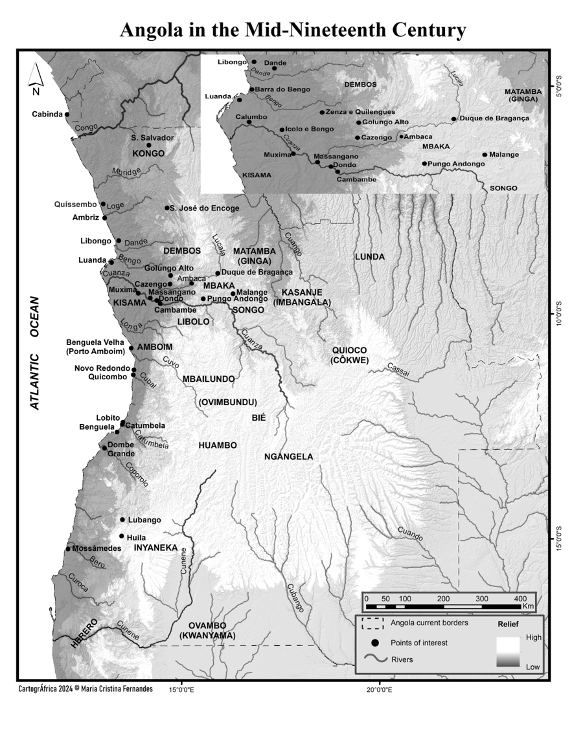
For much of its colonial history, Angola served as a penal colony. From the mid-eighteenth century until 1932, Portuguese courts banished between 45,000 and 50,000 individuals known as degredados (exiled convicts) to Portugal’s overseas territories, including Angola. Degredo (exile) was not just a punishment but also a means of addressing labour shortages overseas, particularly in the military. Depending on the severity of the offence and the status of the offender, sentences ranged from just a few years to perpetual banishment. Although convicts could be sent from and to any part of the Portuguese empire, Angola became the main destination for degredados in the nineteenth century. In 1864, the colony had 818 degredados, distributed across five main districts: Ambriz, Luanda, Moçâmedes, Benguela, and Golungo. Of this total, 433 lived in Luanda, the colonial capital of Angola, where they represented nearly one-third of the white population.
Initially, conditions in the colony were difficult. Angola had a reputation as a “white man’s grave,” and degredados were often victims of malaria and other endemic diseases. They also faced harsh military discipline and were used as a source of forced labour. Yet degredo could also create economic and social opportunities. With so few white settlers in the colony, degredados rose through the military ranks, were appointed to positions in the colonial administration, and acquired land and enslaved people. A few even became wealthy through the slave trade, the colony’s main economic activity. Between 1501 and 1867, an estimated 12.5 million enslaved Africans were forcibly shipped across the Atlantic to the Americas and Europe. Of these, approximately 2.8 million embarked from Luanda, the largest slave port in the Atlantic slave trade. Most were taken to the Brazilian ports of Rio de Janeiro, Recife, and Salvador.
Since the 1970s, degredados have attracted significant scholarly attention. In his 1978 study, Gerald Bender described degredados as “murderers, arsonists, and perverts” who posed a major threat to both Africans and Europeans. For Bender, the continued use of convict labour epitomized the failures of Portuguese colonialism and further contributed to Angola’s poor reputation. Recent scholarship has taken a more nuanced approach. Geraldo Pieroni argues that degredados should not be treated as a uniform group, noting that many were banished for violating religious and social conventions rather than for serious offences. Selma Pantoja has shown that many of the women banished to Angola in the late nineteenth century came from the lower ranks of Portuguese society, with several convicted of infanticide. Timothy J. Coates, meanwhile, argues that degredo was not simply a form of punishment. Rather, the Portuguese Crown used convicts as soldiers, settlers, labourers, and colonial agents, making them an important instrument of imperial expansion. This paper builds on this scholarship by focusing on the lived experiences of degredados and their role within the broader transformations of Angola’s economy.
It also complicates existing scholarship on nineteenth-century Angola. To date, much of the scholarly work on degredados in the nineteenth century has focused on the slave trader and degredado Arsénio Pompílio Pompeu de Carpo, who has been the subject of biographical studies by Carlos Pacheco, Jacobo Corrado, and João Pedro Marques. However, by focusing on figures such as Carpo, scholars have tended to simplify the convict experience, often portraying it simply as a pathway to wealth. While degredados were often mobile and could become successful traders in the colony, this paper demonstrates that their experiences were varied and shaped by nineteenth-century economic transformations. It also shows that degredo was not static. In the 1870s, the Portuguese colonial administration introduced measures to regulate and control the convict population as part of Portugal’s attempt to establish “effective” occupation. It therefore offers a more complete account of degredo that moves beyond exceptional cases to examine the reality on the ground.
Exile, Labour, and Mobility in Colonial Angola
Since the seventeenth century, degredo was firmly entrenched under Portuguese law. According to the Ordenações Filipinas, the law in Portugal and its overseas territories from 1603 to 1852, minor offences, including insulting an official, could be punished with internal exile to Castro Marim in the Algarve, while serious crimes like murder could result in banishment to parts of Africa and Brazil. Depending on the severity of the crime and the status of the offender, sentences ranged from a few years to perpetual exile, with the possibility of appeal before the Casa da Suplicação (Higher Court of Appeals) in Lisbon. Later, High Courts were also established in Porto, Goa, Bahia, and Rio de Janeiro. Through these courts, as well as Inquisition tribunals, approximately 50,000 convicts and “sinners” were exiled “multi-directionally” across the empire and between colonies from 1550 to 1755. From the 1750s until 1932, Portuguese courts alone banished another 45,000 to 50,000 people.
Because of its notoriously unhealthy environment, Angola was typically reserved for those who had committed serious crimes like murder and any of the four “unpardonable” offences: heresy, sodomy, treason, and counterfeit. The Crown viewed unpardonable offences as threats to the religious, political, social, and financial foundations of the kingdom. However, degredo was also contingent upon imperial needs. Labour shortages, a lack of white settlers, and a desire to rid the kingdom of “undesirable” people led to the banishment of thieves, vagrants, political prisoners, and religious and ethnic minorities. Although women were also exiled to the colony, most degredados banished to Angola were men. During the early modern and modern period, white women were generally considered ill-suited for the tropics and were rarely sent to Angola unless they were accompanying their husbands or fathers. However, those banished to the colony were often exiled for serious offences, some of which reflected gendered expectations. Infanticide, for instance, was considered a particularly serious crime because it violated prevailing notions about a woman’s maternal role. Due to the near absence of foreign women, male convicts often engaged in casual and long-term relationships with local women, who acted as translators and helped convicts build crucial networks. Through these relationships, some African and Luso-African women acquired wealth, which they invested in captives, ships, land, and luxury items. The most successful among them were known as donas (ladies) and were classified as “white” in colonial censuses, regardless of their skin colour. The degredado Germano Francisco da Câmara, for instance, married a woman from Benguela named Dona Luísa da Fonseca Negrão in 1847. By the 1850s, he was working as a merchant in the colony.
Before the late nineteenth century, degredados were often enlisted in the colonial army and sent to presídios (outposts) in the hinterland to build fortifications and perform manual labour. In a letter addressed to Lisbon’s Overseas Council from October 1798, Governor Miguel António de Melo wrote that almost all the soldiers in the colony were degredados from Portugal or Brazil who had committed serious or “atrocious” crimes. However, these degredados were rarely confined unless they posed a threat to security. On 25 June 1824, Governor Cristovão Avelino Dias informed the capitão-mor (captain-major) of Muxima Francisco Luiz Moreira that he was sending him the soldiers and degredados António José de Sousa and António José Rodrigues. Both were to be chained as “customary” for instigating a rebellion. Degredadas (female convicts) were also sent to presídios to perform domestic labour and support the garrison. On 13 November 1856, the 29-year-old Portuguese degredada Maria Joaquina died at the presídio of São José de Encoge, after being banished to the colony for matricide.
Others lived and worked in Luanda. Male convicts performed a variety of jobs, including owning taverns where people from different backgrounds and social statuses gathered to socialize, gamble, and drink. These establishments were frequently targeted by the police, who viewed them as sites of disorder, drunkenness, and crime. On 8 October 1858, police arrested an enslaved man belonging to Veríssimo Lopes de Moura after he was caught attempting to steal from a tavern owned by the degredado Feliciano Carlos Fernandes do Couto. Degredados also worked in skilled trades. João Domingues de Oliveira Camarinha, who was originally from Vila Nova de Gaia, Portugal, arrived in the colony in 1859. When he died on 5 January 1865, he was about 38 years old. Before his death, he was working as a carpenter and owned a workshop in Luanda.
Female convicts, by contrast, had fewer economic opportunities and were largely confined to domestic work that was poorly paid. For instance, the Portuguese degredada Francisca Rosa was working as a seamstress. In May 1869, Francisca was arrested in Luanda for stealing clothing from someone named José dos Santos Paiva. Because economic opportunities for women were so limited, some degredadas entered relationships with male convicts for companionship and to secure greater economic stability. However, these relationships could also be marked by violence. In October 1877, police arrested the degredados António de Andrade and Maria de Jesus for murdering a Spanish resident, Maria da Conceição Navarra, whose body was later found buried in Andrade’s backyard alongside a large quantity of clothing. The reasons for the crime, and the outcome of the case, remain unknown. At the time, Andrade and Maria de Jesus were in a relationship.
Nonetheless, conditions in the colony were difficult. Degredados contracted malaria and dysentery, or suffered from fevers, gastrointestinal issues, bronchitis, and other ailments. In March 1821, 300 convicts from Naples arrived in the colony as part of an agreement between the Kingdoms of Portugal and Sicily. By 2 August 1821, three were “gravely” ill in Golungo Alto. In June 1865, the colony’s Director of Health, José Maria de Bulhões Maldonado, reported that 414 people had been admitted to Luanda’s military and civil hospital, 283 of whom were European military personnel. Of the 31 people who died, most were degredados not yet “accustomed” to the climate. Convicts serving in the army could also be subjected to beatings, a common punishment for desertion, insubordination, and other offences. In early March 1880, the degredado Francisco Ramos attacked the president of the municipal council and a military surgeon with a knife. On 6 March, he was sentenced under military law to varadas (lashes). After the punishment, Ramos was confined in a police cell for nearly two days without medical care. When he was examined on 8 March by Inácio Caetano Xavier, the military physician on duty, his condition had deteriorated, and he later died in hospital. Because of these difficult conditions, degredados often fled to areas outside Portuguese control, where they lived independently or escaped to Brazil. In August 1826, Governor Nicolaude Abreu Castelo Branco warned the commander of the Brazilian warship Cândido Francisco Brito da Victoria to be on the lookout for two escaped convicts, Manuel da Costa Lagos and António Joaquim. Both had boarded a small boat bound for Cabinda, a port near the mouth of the Congo River under the authority of the African Kingdom of Ngoyo. From there, they likely escaped on a slave ship to Brazil. On 24 September 1827, Governor Castelo Branco again complained that degredados were fleeing to ports north of Luanda, and that at least four had fled a day prior.
Degredados also attempted to leave the colony through formal legal channels. In June 1855, the degredado José Fructuoso Martins e Silva petitioned for a pardon, citing good behaviour. He had been banished to the colony for fifteen years for murder and had arrived in March of that year. In October 1866, Maria da Estrella, who had been sentenced to fifteen years of degredo in Angola and had served four years of her sentence, petitioned for permission to complete her term on the island of São Tomé, where she had family. Even convicts who had achieved economic success in the colony petitioned for pardons. Anselmo Marracho was banished from Portugal to the colony in 1859. In 1869, he petitioned for a pardon, offering a substantial donation to the orphanage in exchange. The request appears to have been denied. By 1874, he petitioned for his brother António Joaquim Marracho, then serving degredo in São Tomé and Príncipe, to be transferred to Angola so that he could work in a store Marracho owned. However, the case of José Lourenço Marques demonstrates that degredados could also achieve success in the colony and be appointed to important positions in the colonial administration. Marques was born in Portugal around 1793. By around 1815, he was serving in the Royal Naval Brigade in Rio de Janeiro, when the Conselho de Guerra (War Council) found him guilty of conspiring to commit bodily harm and sentenced him to ten years of degredo in Angola. Upon arriving in Luanda in 1815, he was assigned to military service. Despite receiving 25 varadas for insubordination in August 1816, he was promoted to ensign in 1821 and to lieutenant in 1836. By 1847, Marques was Luanda’s chief of police, a position he held until his retirement in October 1866. Like many foreign men in the colony, he married a local woman, Dona Filippa da Silva Mourão, who came from a prominent family. Together, they owned slaves and arimos (large farms).
A few degredados even became wealthy slave traders. The Italian medic Carlos Ubertali was banished to Angola around 1822 for political crimes. By the 1830s, he owned captives, land, and gunpowder and was involved in the slave trade to Cuba and Pernambuco. António José Cabral de Melo Pinto was convicted of murdering his wife, Dona Maria dos Prazeres de Abreu Soares de Melo Magalhães, in Lisbon in 1822. In 1826, he was banished to Angola. Within a few years of arriving in the colony, he was serving as crown judge of Luanda’s comarca (judicial district). In 1831, he married Dona Teresa Luísa, the daughter of Dona Ana Joaquina dos Santos Silva, one of the colonies wealthiest slave traders. Before his death in 1833, he owned slave ships and held wealth in Rio de Janeiro and Bahia.
Degredados and the Illegal Slave Trade
After years of pressure from Britain, the Portuguese premier Marquis Sá da Bandeira banned the Portuguese slave trade on 10 December 1836. Subsequently, vessels seized by the Portuguese navy on suspicion of participating in the illegal slave trade were to be tried before the local Juiz de Direito (Judge of Law). If declared “a good prize,” the enslaved people on board were to become libertos (freed), an intermediate status between slavery and freedom. Before gaining the rights and responsibilities of full emancipation, libertos were required to complete a period of apprenticeship. In 1842, Portugal then agreed to an anti-slave trade treaty with Britain that allowed the British navy to search and seize Portuguese vessels suspected of participating in the slave trade and established a joint Anglo-Portuguese Mixed Commission Court in Luanda to try suspected slave ships. By the mid-nineteenth century, Britain, Brazil, France, Portugal, and the United States were actively suppressing the slave trade along the Angolan coast. Consequently, the number of enslaved people shipped from Luanda declined from about 137,906 in 1836-1840 to 29,947 in 1841-1845. Although slave embarkations increased slightly in the 1846-1850 period, Brazil’s 1850 ban on the slave trade effectively brought the trade from Luanda to an end.
Without its main outlet for captives, Luanda’s economy gradually transitioned from one dominated by the export of enslaved people to the “legitimate” commerce of raw materials and tropical commodities, including ivory, coffee, beeswax, cotton, gum copal, palm products, and groundnut oil. However, this transition relied on the forced labour of slaves, libertos, and degredados. In 1844, 100 libertos recently “rescued” from slave ships were sent to work on the arimo Camongoa in Cambambe, which was then owned by the Public Treasury. By 1849, the Secretary General Francisco Joaquim da Costa e Silva requested one or two degredados who were “acclimatized” and capable of working the plow on the arimo Camongoa. When Sebastião Lopes de Calheiros e Menezes became governor in February 1861, he sent “large numbers” of degredados and libertos to the hinterland of Moçâmedes to work in coffee and sugarcane production.
On these properties, degredados often occupied ambiguous positions, sometimes working alongside enslaved people and libertos, and at other times managing them. In May 1868, an enslaved carpenter named Francisco fled from the fazenda (plantation) Santa Emília do Columein the Dembos after being persuaded by the degredado Custódio Rodrigues, who also worked there as a carpenter. However, degredados could also act as overseers. On 24 March 1851, a 54-year-old degredado from Braga, Portugal named Manuel José Rodrigues died of typhoid fever in the District of Icolo e Bengo. At the time of his death, he was the overseer of an arimo. Legitimate commerce not only depended on forced labour but was also compatible with the slave trade. To evade naval authorities, slave traders relocated to ports in the south, mainly Novo Redondo, Quicombo, Lobito, Egito, Catumbela, Bahia Farta, Benguela Velha and Moçâmedes, and ports in the north, including Ambriz, Mayumba, and the African-controlled ports of Cabinda, Molembo, and Loango. Since the United States had not signed an anti-slave trade treaty with Britain, they also used American flags to conceal their operations. Slave traders also began sending captives to remote locations near the Congo River, where they awaited embarkation in barracoons.
Degredados were among those involved in this illegal slave trade. The most well-known example was Arsénio Pompílio Pompeu de Carpo. He was born in 1792 in Funchal, Madeira, most likely in the freguesia of São Pedro, to Dona Joana Rosa and André João dos Santos. His wife was Dona Domingas Rosa de Vasconcelhos, with whom he had at least two daughters, Augusta and Maria, and a son Arsénio Pompílio Pompeu de Carpo Junior. Accused of criticizing the government and making sarcastic remarks about the Church, Carpo was sentenced in 1823 to five years in a presídio in Angola. When Carpo arrived in the colony in 1824, he was enlisted in the army. By 1826, he owned a store and a tavern in Luanda. Around this time, Carpo became acquainted with the slave trader Ângelo Francisco Carneiro, who had arrived in Luanda from Pernambuco in 1824. After serving his sentence, Carpo later moved to Pernambuco with his family, where historians suspect he continued working for Carneiro.
Shortly after Sá da Bandeira’s 1836 ban on the Portuguese slave trade came into effect, Carpo returned to the colony in the hope of profiting from the illegal slave trade, leaving his wife, Dona Domingas Rosa, and their children in Brazil. When he arrived in Luanda in 1837, he first served as a consignee for the slave trader Francisco Teixeira de Miranda, a representative of a commercial house in Rio de Janeiro. Through Miranda, Carpo also met the slave trader Francisco António Flores, who had arrived from Brazil in the early 1840s, and Dona Ana Joaquina, one of Luanda’s wealthiest slave traders. By at least 1843, the four had become business partners and attempted to establish a steamboat company for the export of legitimate products. However, the project collapsed amid accusations that they planned to use the steamboat for the slave trade to Brazil. Carpo also had a relationship and family with a Luso-African woman named Dona Antónia Josefa da Silva, who became his amásia (concubine) in the late 1830s. They lived together until 1849, when Dona Domingas and their children joined Carpo in Angola.
Because of the risk of capture, Carpo adopted strategies to evade naval authorities. When the German doctor Gustav Tams arrived in Luanda on a commercial expedition led by the Portuguese consul-general of Altona, José Ribeiro dos Santos, in 1841, he learned that Carpo embarked captives at night to conceal his illegal activities. Carpo also shifted his operations to other Angolan ports, including Ambriz. In 1841, Commander E. H. Butterfield of the Waterwitch captured his vessel Euro in Ambriz with 314 captives on board. To ensure the secrecy of his operations, Carpo even relied on family members, including his nephew and son-in-law, Luís de Oliveira Machado. By the early 1840s, Machado was involved in the illegal slave trade and worked as Carpo’s clerk in Ambriz until his death in 1864. These measures, combined with the effects of Brazil’s 1850 ban on slave imports, eventually took their toll. Cut off from Brazilian markets, Carpo fell deeply into debt. Following an investigation by the Junta de Justiça (Board of Justice), Carpo was convicted of fraud in 1852 and sentenced to ten years of degredo in São Tomé. However, a year later his sentence was revoked in Lisbon, and Carpo returned to Angola, where he was elected to Luanda’s municipal council and appointed governor of the interior administrative outpost of Ambaca. By the 1860s, Carpo had become involved in the rubber and wax trade at Kasanje, where he died in 1869.
Although Carpo is arguably Angola’s most well-known convict, other degredados participated in the illegal slave trade, including Manuel José Constantino. Little is known about his early life or his crimes, except that he was banished from Portugal to the colony for life and was already involved in the illegal slave trade to Brazil by the 1830s. In 1837, Constantino was in Brazil travelling with an enslaved person. By the 1840s, he owned a house near the quitanda (outdoor market) close to the Church of Nossa Senhora dos Remédios in Luanda and was working as an agent for the slave trader Gabriel António. During this period, Constantino also owned slave ships, including the Maria Luiza, Carlota, Bom Sucesso, and Fortuna, and engaged in legitimate commerce, owning coastal vessels such as the Rio Dande, which transported goods along the coast. By the late 1840s, Constantino’s activities came under increasing scrutiny, prompting him to flee to Rio de Janeiro aboard the vessel Igual. For slave traders, Brazil could offer both refuge from prosecution and potential allies. In September 1848, Angola’s governor, Adriano Acácio da Silveira Pinto, instructed João Baptista Moreira, the Portuguese consul-general in Rio de Janeiro, to apprehend Constantino and return him to Luanda for punishment. On 9 January 1849, Moreira reported to the governor that there was no trace of Constantino and that the Igual had never docked in Rio de Janeiro. This account is difficult to verify, but Moreira had a long history of supporting the illegal slave trade and accepting bribes from slave traders.
The Serviçal Trade
Alongside measures to abolish the slave trade, Sá da Bandeira passed laws gradually abolishing slavery throughout Portugal’s overseas territories. On 14 December 1854, a decree required slave owners in the Portuguese colonies to register their slaves within 30 days, with all unregistered captives classified as libertos. In 1858, the government legislated that slavery would be abolished within twenty years, setting 29 April 1878 as the final date for full emancipation. On 25 February 1869, the Portuguese government decreed that all slaves in the overseas colonies would become libertos, though they were still required to serve their former owners until emancipation in 1878. In 1875, the status of liberto was abolished and replaced by that of the serviçal (indentured labourer). Nonetheless, these laws had little effect beyond the coast, which remained under African control. In the mid to late nineteenth century, slavery increased in the interior of Angola, and the internal slave trade expanded alongside the export of ivory, wax, and rubber. This trade was dominated by the Ovimbundu people, who inhabited the central plateau. As Linda Heywood has pointed out, a collective “Ovimbundu” identity did not exist until the late nineteenth century.During this period, the “Ovimbundu” were divided into several independent and competing states, including Mbailundu (Bailundo), Viye (Bihé), Wambu (Huambo), Ciyaka (Quiaca), among others. For weeks and even months at a time, Ovimbundu caravans transported ivory, beeswax, and rubber from the interior to trading houses in Benguela, Catumbela, and Novo Redondo. These caravans also supplied captives who were then shipped to coffee and cocoa plantations in São Tomé and Príncipe or retained locally on plantations as serviçais.
Taking advantage of these economic opportunities, degredados settled in the Ovimbundu heartland, where they became involved in the slave trade and came into conflict with African rulers. In November 1879, a soba (African ruler) named Mafinja accused the ex-degredado José Maria Agostinho, who lived in the district of Huíla, of attempting to depose him and of engaging in slavery. A few months later, another soba, Cancande, filed a similar complaint with the chefe (chief) of Huíla, Francisco António de Mesquita. He accused Agostinho of mobilising serviçaisin support of a rival claimant named Sebolla.
João Victor da Silva Brandão, one of Portugal’s most notorious convicts, offers another example of a convict who became involved in the slave trade. Brandão had led a murderous gang composed of close friends and family members and was exiled to Angola in 1870 for killing a priest. After arriving in Luanda, he made his way to Benguela and then to Catumbela, where by 1880 he was managing the plantation Cassequel, then owned by the Portuguese landowner Desiré Lourenço Eduardo Braga. In April 1880, two serviçais from the fazenda, Ignácio and Urica, accused Braga and Brandão of attempting to enslave them. According to their testimony, Brandão forced them, along with several other serviçais to leave the fazenda under the supervision of a white employee named Diamantinho. Suspecting that they were being enslaved, Ignácio and Urica fled to Benguela. According to the colonial official, Francisco António Pinto, Brandão and an associate named Mendonça had previously attempted to illegally ship two serviçais to Moçâmedes. One escaped before boarding the vessel, while the other was sold to a planter but managed to flee after several days. To avoid prosecution, Brandão fled to Benguela.
The Scramble for Africa and Controlling the Convict Population
The expansion of the internal slave trade in Angola coincided with the “Scramble for Africa,” a period of intense European competition for African resources and strategic ports. During this period, Portugal sought to exploit the resources of its African colonies while reinforcing its claims to the continent. The Sociedade de Geografia de Lisboa (Geographical Society of Lisbon) played a key role in mobilising support for Portugal’s colonial ambitions. Established in 1875 by industrialists, scholars, and colonial and military officials, the SGL was central to organising expeditions to Angola in the 1870s and 1880s. These missions aimed to expand knowledge of Angola’s interior, open it to commerce, define the colony’s northern and southern boundaries, and promote support for the “Rose-Coloured Map,” an ambitious proposal for a continuous Portuguese empire linking Angola and Mozambique.
Efforts to assert “effective” control over the colony also included attempts to encourage white settlement. However, Angola did not attract significant numbers of white settlers until the twentieth century. Consequently, the Portuguese crown relied on degredados to establish a colonial presence. According to the Portuguese explorer Henrique Augusto Dias de Carvalho, 2,083 convicts arrived in Angola between 1863 and 1873. By 1875, roughly 40 degredados were leaving Portugal each month, with around 20 to 30 arriving in Angola, while the remainder disembarked in São Vicente, Santiago, and São Tomé and Príncipe. However, their presence further reinforced Angola’s poor reputation. When the British mining engineer Joachim John Monteiro visited Angola in the 1850s and 1870s, he observed that degredados “rob and cheat and in a few years become rich and independent and influential personnages.” In September 1876, Governor Caetano Alexandre e Almeida e Albuquerque complained that degredados, especially those living in cities, succumbed to vice, becoming “industrious and cunning wrongdoers, no less, and perhaps even more, dangerous.”
Relying on convicts but concerned about their behaviour, colonial authorities sought to regulate and control them. On 22 July 1877, the Luanda administration ordered the closure of all taverns owned by convicts. In August 1880, Governor António Eleutério Dantas barred degredados from serving in Luanda’s police, arguing that a “civilized” force should be composed of men of good character. Authorities also increasingly redirected convict labour into public works projects, which experienced in expansion. On 19 May 1875, Claudino Augusto Carneiro de Sousa e Faro, Director of Public Works in Luanda, ordered all degredados with a trade to report to the Public Works Department, while those without a trade were assigned as general labourers. Once state projects no longer required their services, skilled convicts could enter private employment under guarantees provided by employers, who assumed responsibility for their conduct. One of the major public works projects that used convict labour was the Maria Pia Hospital. Hospitals were not only seen as essential for addressing Africa’s reputation as a “white man’s grave,” a major obstacle to attracting settlers, but also for projecting an image of European scientific and technological superiority. The project began in 1875 with support from João de Andrade Corvo, the Portuguese Minister of the Colonies, and was directed by Faro, Angola’s Director of Public Works. Faro designed a six-storey building to meet “the highest standards of colonial hygiene.” By 19 July 1882, the explorer Henry Morton Stanley observed that “some hundreds of convicts from the mother country” were grading, excavating, and levelling the entrances of Hospital Maria Pia. When the hospital was completed in 1890, Henrique Augusto Dias de Carvalho praised its furnishings, modern equipment, laundry facilities, kitchens, gardens, clinical services, and food, calling it a “model hospital, honouring the work of the Portuguese in Africa and admired by foreign visitors.”
Convicts also contributed skilled labour. In the late nineteenth century, Luanda had become a centre for long-distance trade. Between 1870 and 1872, rubber exports through Luanda and Benguela increased from just 759 kilograms to over 360 tons. Much of the trade passed through Dondo, a key commercial outpost on the Kwanza River and the furthest inland point accessible by steamer. Porters carried goods from Pungo Andongo, Golungo Alto, and Malanjeto Dondo, where they were then shipped to Luanda on steamers operated by the Quanza River Steam Navigation Company. To support the growing volume of trade, a telegraph line was installed linking Luanda to key points along the Kwanza River. Degredados were likely employed in its construction and operation. On 23 June 1877, the degredado Luiz Correa Mellowas ordered to present himself to the Director of Public Works. At the time, he was a telegraph operator.
Alongside these labour policies, colonial authorities sought to control degredados by restricting their mobility and residence. On 6 July 1876, the colonial administration ruled that convicts had to declare their place of residence and report any change within 24 hours. They were also not allowed to travel more than four kilometres from where they resided. A few months later, on 15 September 1876, Angola’s Governor Caetano Alexandre de Almeida e Albuquerque established a prison to house convicts within Luanda’s Fortress of São Miguel, called the Depósito de Degredados. The prison was organised into five companies: the first two comprised male prisoners from Portugal, the third held male prisoners from the Atlantic colonies, including Cape Verde, Portuguese Guinea, and São Tomé, the fourth consisted of women, and the fifth was made up of male vagrants. Convicts held in this prison were either leased to private parties, the colonial state, or worked within the Depósito itself*.* Women, in particular, worked in the hospital doing laundry, carrying for the sick, and sewing clothes.
Finally, to support agricultural development, encourage settlement, and reform convicts, the colonial administration experimented with penal colonies. However, these efforts were largely unsuccessful. One such penal colony was Esperança, established on 15 September 1883 at Calanbo Quingungi in the Malanje district. In 1886, it was dissolved due to high mortality rates. At least thirty-three convicts had died in Esperança and an additional 11 had died after returning to Luanda. A second colony, Rebelo da Silva, was created by decree in November 1885 in Caconda, but it faced similar challenges.
Conclusion
In conclusion, this paper has focused on degredados on the ground and how they both shaped and were shaped by nineteenth-century economic transformations. Although exile was difficult and many degredados died, the paper shows that for some convicts degredo created economic opportunities, particularly through the slave trade, and that convicts adapted to changing economic conditions. However, these opportunities were more limited for women. Moreover, degredo was not static. While convicts initially enjoyed a degree of mobility, by the 1870s increasing efforts were made to control their labour and movement, suggesting that degredo evolved in response to shifting colonial labour demands and imperial expansion.
About the Author
Dr. Tracy Lopesis a contributor with Written in the Waves. You can read her full profile here.